
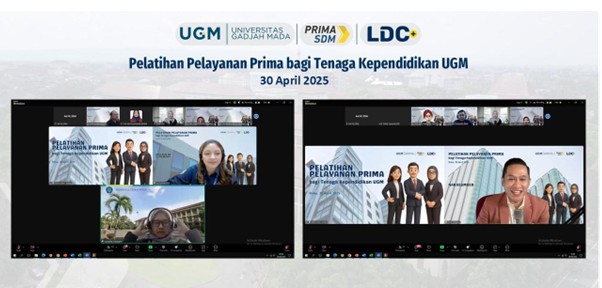
Yogyakarta, April 30, 2025 – Universitas Gadjah Mada (UGM) has once again demonstrated its commitment to improving service quality and professionalism by organizing the Excellent Service Training (Pelatihan Pelayanan Prima) for educational staff. Held on April 30, 2025, the program brought together 144 participants from various faculties, schools, and central administrative units, with the largest proportion (59%) representing academic units and 41% from the Central Administration Office (KPTU).
This initiative aimed to equip staff with enhanced attitudes, behaviors, and service skills to better serve UGM’s diverse stakeholders, including students, faculty, and external partners. Participants represented a broad demographic: 62% male and 38% female; the majority were between 41–50 years old (37%), followed by those aged 31–40 years (33%), with others spanning younger and older age groups. Most participants were UGM employees (76%), while 24% were civil servants (PNS).
Comprehensive Curriculum and Inspiring Facilitators
The training featured a carefully designed curriculum combining technical service competencies with UGM’s core values. Distinguished facilitators delivered sessions on topics such as UGM Values as the Foundation of Excellent Service (Dr. Heri Santoso), Core Job Competencies in Service Excellence (Indrayanti, S.Psi., M.Si., Ph.D., Psi.), and multiple sessions by Ferry Anggara covering Building Service-Oriented Attitudes and Behaviors, Effective Communication for Excellent Service through Technology, and Professional Grooming.
These sessions were particularly well received, with over 90% of participants rating them as highly relevant and useful. One participant remarked, “This training was like a mirror that reminded us to appear professional and become trustworthy individuals.” Another highlighted that it offered “a holistic learning mosaic—touching not only on technical skills but also UGM’s values that ground our service culture.”
Strong Satisfaction with Implementation and Facilities
Evaluation results showed very high levels of satisfaction across all components. More than 83% of respondents strongly agreed that the organizing committee provided professional, responsive, and courteous service. The supporting facilities, including Zoom Meetings and UGM’s eLOK Learning Management System, were also rated positively, with 79% strongly agreeing that Zoom supported the training effectively, and 65% endorsing eLOK as a valuable tool for accessing materials.
While the online format ensured broad participation, many participants expressed enthusiasm for more interactive models in the future. Around 42% suggested offline sessions and 18.5% proposed hybrid formats, combining online theory with in-person practical sessions. This reflects the strong demand for experiential learning that allows staff to apply concepts more directly in real-world service contexts.
Constructive Feedback and Future Aspirations
Participants praised the training as “very useful for facing students, faculty, and external partners,” while others suggested that it should be held more frequently—every two to six months—so that more staff can benefit. Several emphasized the importance of continuing modules such as professional grooming and public speaking, which were seen as directly enhancing service excellence at UGM.
The evaluation also revealed broader training needs in areas such as digital literacy, communication, administrative management, multimedia, leadership, and mental health—highlighting the evolving skill set required for educational staff in today’s higher education landscape.
Building a Culture of Service Excellence at UGM
Overall, the Excellent Service Training was seen as both a practical skills workshop and an inspirational reminder of UGM’s identity as a leading institution that values integrity, professionalism, and dedication. Many participants described the experience as a “boost of spirit and awareness that excellent service is not just a job requirement but a true act of devotion.”
The Directorate of Human Resources affirmed that the overwhelmingly positive feedback will be used to strengthen future training, with a focus on interactive, sustainable, and needs-based programs. As UGM continues to cultivate a culture of service excellence, this training stands as a milestone in reinforcing the values and competencies that define its staff as role models for higher education in Indonesia.
—
(HR/Rista)
