
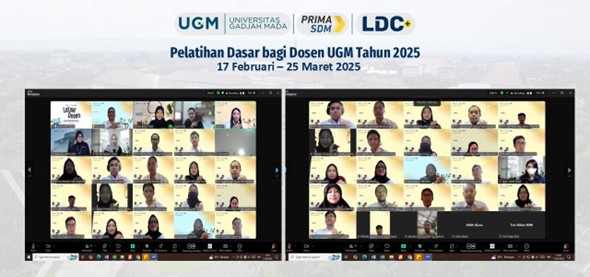
Yogyakarta, Indonesia — Universitas Gadjah Mada (UGM) successfully organized the 2025 Basic Training (Pelatihan Dasar or Latsar) for new lecturers, held over two phases on February 17–21, 25 and March 25, 2025. The training, facilitated by the Directorate of Human Resources, aimed to reinforce the academic values, ethical standards, and institutional vision expected from lecturers as integral parts of the university’s academic community.
This year’s Latsar brought together new faculty members from diverse academic units, including the Faculty of Mathematics and Natural Sciences, Faculty of Economics and Business, Faculty of Biology, Faculty of Social and Political Sciences, Faculty of Medicine, Public Health, and Nursing, Faculty of Psychology, Faculty of Agriculture, Faculty of Dentistry, and the Faculty of Agricultural Technology. A total of 24 academic units were represented, reflecting the breadth of UGM’s multidisciplinary environment.
The participants—comprising 50% doctoral graduates, 45.83% master’s degree holders, and 4.17% specialists—engaged in intensive sessions covering key themes such as university governance, academic integrity, research ethics, higher education leadership, and the integration of UGM’s core values into the Tri Dharma (teaching, research, and community service). The sessions were led by prominent figures in UGM’s leadership, including Vice Rectors, Deans, and senior academic leaders.

Fostering Academic and Personal Growth
A central component of the training focused on “Why Become a Permanent Lecturer at UGM?”, which invited lecturers to reflect on their motivations through the lens of UGM’s philosophical and ethical foundations. Lectures delivered by figures such as Prof. Dr. Supriyadi (Vice Rector for Human Resources and Finance) and Dr. Arie Sujito (Vice Rector for Student Affairs, Community Service, and Alumni) helped participants internalize the university’s strategic goals in human resources, education, and public service.
Participants also explored practical dimensions of academic professionalism, including academic writing and research proposal development, career planning, use of digital systems such as SIMASTER and eLOK, and sessions on innovation in teaching in the era of Society 5.0.
Feedback gathered from participants revealed high levels of satisfaction, with over 90% of respondents rating sessions as “very good” across themes such as ethics, curriculum relevance, instructional quality, and administrative organization. One participant shared, “Latsar is very engaging and the materials truly expand our perspectives as new lecturers at UGM.” Another highlighted the program’s structure, saying, “The training was well-organized and all speakers were experts in their field. It was never boring.”

Building a Stronger Future Through Educator Empowerment
Beyond content delivery, the Latsar program provided space for participants to connect, collaborate, and reflect on their roles not only as educators and researchers but also as ambassadors of the university’s values. Many participants suggested that future Latsar programs include more in-person sessions and be scheduled during academic intermissions to enhance engagement.
The Director of Human Resources, Prof. Suadi, S.Pi., M.Agr.Sc., Ph.D., emphasized that this program is part of UGM’s broader effort to build a sustainable academic ecosystem. “UGM believes that empowered and ethically grounded lecturers are the backbone of academic excellence. Through Latsar, we are not only equipping our faculty with skills but also anchoring them to the values that define us,” he said.
With its comprehensive curriculum, outstanding facilitation, and strong alignment with UGM’s 2022–2027 Strategic Plan, the 2025 Basic Training for New Lecturers stands as a testament to the university’s commitment to continuous quality improvement and institutional development.
—
(HR/Rista)
