
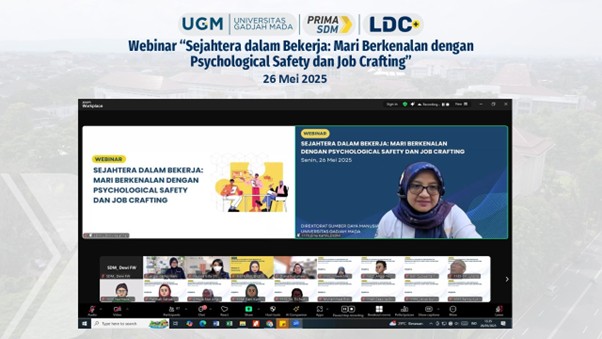
Yogyakarta, May 26, 2025 – Universitas Gadjah Mada (UGM), through its Directorate of Human Resources, successfully hosted the Webinar on Workplace Well-being: Getting to Know Psychological Safety and Job Crafting. Conducted online via Zoom, the program was attended by 163 educational staff (Tendik) from across faculties, schools, and administrative units.
The webinar was designed to introduce participants to two crucial concepts in modern organizational life: psychological safety—the shared belief that one can speak up, take risks, and express ideas without fear of negative consequences—and job crafting, the proactive redesign of work roles to create more meaningful, productive, and fulfilling experiences.
Diverse Participation Across Units and Backgrounds
The event drew participants from diverse professional and educational backgrounds. Gender distribution was nearly equal with 51% male and 49% female participants. The majority of attendees fell within the 41–50 age group (34%), followed by those aged 31–40 (29%), while staff over 51 years (21%) and those aged 20–30 (16%) also made up significant portions of the audience.
In terms of educational attainment, most participants held a Bachelor’s degree (45.9%), while others had senior high school education (24.1%), Master’s degrees (15.3%), or diplomas (12.4%). From the employment perspective, 64% were UGM staff and 36% civil servants (PNS), with 78% representing the Central Administration Office (KPTU) and 22% from faculties and schools. This broad participation underscored the relevance of the topic across all levels of UGM’s workforce.
Positive Reception of Materials and Delivery
Participants responded enthusiastically to the content and facilitation. The curriculum was considered systematic and highly relevant, with over 92% rating the materials appropriate and aligned with current developments. Facilitators Kuni Aisyah Habibah, S.Psi., and Linati Amalia Rosadi, S.Psi., were praised for delivering clear, engaging, and thought-provoking sessions that resonated with the realities of workplace dynamics.
Feedback highlighted that the theme was both novel and essential. One participant commented, “This is a new topic that has never been introduced in training before—very refreshing and insightful.” Another noted, “The webinar was not only useful for work but also for everyday life with family and community.”
Strong Satisfaction with Organization and Facilities
The technical implementation was also highly rated. Over 94% of respondents praised the adequacy of facilities, including visual, audio, and interactive features. Zoom Meetings as the delivery platform received a 95.7% satisfaction score, ensuring smooth engagement throughout the program.
The training committee earned special recognition for professionalism, with 95.8% of participants agreeing that the team was informative, responsive, and courteous. Comments such as “Bravo HR team!” and “Outstanding beyond expectations!” reflected the high level of appreciation for the organizers.
Feedback and Aspirations for the Future
While the majority (60.2%) preferred online sessions, a notable portion expressed interest in hybrid (20.3%) or offline (14.4%) formats to allow for more interaction and networking. Several participants suggested longer sessions and more opportunities for discussion to deepen understanding.
Participants also identified broader training needs for the future, ranging from technical and administrative skills (finance, HR, document management, Microsoft Office, and data processing) to personal and professional development (public speaking, stress management, leadership, and mental health). There was also strong demand for follow-up sessions on workplace well-being, including advanced modules on psychological safety, work-life balance, and strategies to manage toxic environments.
Building a Culture of Well-being at UGM
The success of this webinar highlighted UGM’s forward-thinking approach to human resource development. By addressing workplace well-being alongside technical and administrative skills, UGM is fostering a healthier, more adaptive, and more resilient workforce.
As one participant concluded: “This training gave us the spirit to see service and work not just as tasks, but as meaningful contributions to a supportive community.” With strong enthusiasm and positive outcomes, the Directorate of Human Resources aims to continue advancing similar initiatives to ensure that UGM remains not only a center of academic excellence but also a model of workplace well-being in Indonesia.
—
(HR/Rista)
